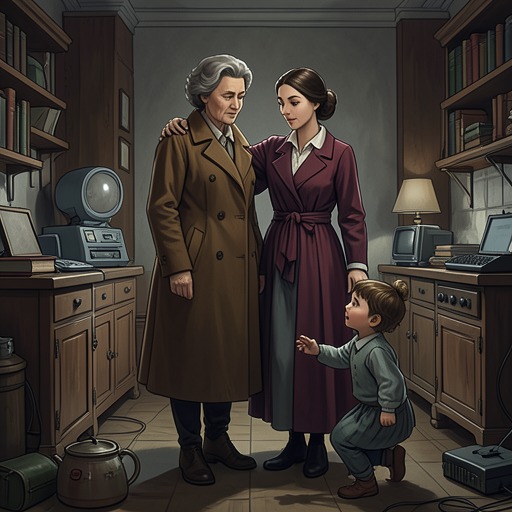
V.I. Warshawski—Louisa Djiak relationship
Blood ShotV. I. Warshawski and Louisa Djiak share an old-neighbor relationship that stretches from V. I.’s childhood in South Chicago to a difficult reunion decades later. Its warmth and strain have the same source: Louisa remembers Gabriella Warshawski’s defense of her, while V. I. remembers both the labor of helping Louisa and the loyalty that bound their families together. When V. I. returns to ask about Caroline Djiak’s father, that history does not settle their disagreement; it makes the disagreement personal.
A bond formed around Gabriella
Louisa’s connection to V. I. was inseparable from her debt to Gabriella. After Louisa became pregnant outside marriage, her parents threw her out, and neighbors treated her as a source of scandal. Gabriella was the one woman on the block who stood up for Louisa. She confronted the pious women from St. Wenceslaus who came to Louisa’s door, defending her against the public judgment that had made the pregnancy seem, to the neighborhood, like a calamity of its own. Louisa later recalled Gabriella emerging to face them with such force that she nearly drove them into the Calumet.
The relationship also ran in the other direction. V. I. remembers that Louisa stood by Gabriella, in life and after her death, and recognizes that Louisa felt she owed Gabriella for that loyalty. The neighbors’ respect for Gabriella after her death did not erase their earlier disapproval of her choices, including her refusal to baptize V. I. or send her to the sisters at St. Wenceslaus. Against that background, Louisa’s defense of Gabriella was more than neighborly politeness: it was an allegiance to someone who had defended her when others condemned her.
V. I.’s childhood place in Louisa’s family
Gabriella’s help became practical as well as moral. When Louisa needed to work the night shift at the Xerxes plant, V. I. helped care for Caroline, Louisa’s baby. She remembers doing homework while the baby cried and spending summer days babysitting. The memory retains an edge: on returning to Louisa’s house as an adult, V. I. admits that she is still angry about having lost those days. Her irritation is not the whole of the relationship, but it prevents childhood service from becoming a polished tale of uncomplicated generosity.
V. I. also took Caroline to her maternal grandparents. She recalls them as rigid and humorless, so hostile to her that they would not let her into their house unless she removed her shoes; on a couple of occasions, they bathed the baby outside before allowing her through the door. Those visits placed V. I. within the practical burdens of Louisa’s family life while exposing the rejection that Louisa and Caroline faced from Louisa’s parents. V. I.’s recollections therefore hold two different forms of care together: her own reluctant, ordinary work of looking after a child, and the larger protection Gabriella had offered Louisa.
Reunion, gratitude, and distance
The women’s connection endured despite distance and gaps in contact. V. I. last returned to the block in 1976, after her father’s death, and later admits that more than two years had passed since she had spoken with Louisa. South Chicago had become a place she was reluctant to let back into her life. Her return is not presented as a simple homecoming: the house looks smaller and dingier to her, and her childhood memories arrive alongside a recognition that Louisa is now seriously unwell.
At Louisa’s bedside, the old closeness reappears in small gestures and direct speech. V. I. pulls a straight-backed chair beside the bed and tells Louisa that she has visited Connie and Louisa’s parents. Louisa is wary, asking what V. I. is doing there, but she also speaks with affection about Gabriella’s daughter. She believes Gabriella would be proud of V. I., even if she might have wished her a more comfortable life, and praises both V. I. and Caroline for their honesty and convictions. V. I. answers that Louisa’s help mattered when Gabriella was sick, though the gratitude makes her uncomfortable. Louisa rejects the idea that her care was a burden or mere repayment: helping Gabriella was, in her view, her chance to return what Gabriella had given her.
Caroline’s history and a new conflict
Their shared history becomes a source of friction when V. I. asks why Louisa’s mother hated Gabriella and whether Louisa’s parents objected to the father of Caroline’s child. Louisa quickly understands that V. I. is investigating Caroline’s parentage. She suspects Caroline sent V. I. to ask, and interprets the inquiry as a threat to the life she has tried to build for her daughter. Louisa says that a man tried to ruin her life twenty-six years earlier and insists that she does not want Caroline near him.
Louisa’s opposition is grounded in protective love, not indifference to Caroline. She says she worked to give her daughter a different chance and cannot bear to see that chance endangered. She also remembers that even after her parents eventually acknowledged Caroline, they never truly forgave either mother or daughter. For Louisa, the past is not an abstract family mystery; it is bound to expulsion, blame, and the possibility that Caroline will be hurt by the man she is seeking.
V. I. acknowledges Louisa’s care for Caroline but draws a boundary between protection and control. She tells Louisa that Caroline is grown and should be allowed to make her own decision. Louisa refuses, orders V. I. to leave if she continues, and breaks into coughing as the confrontation intensifies. Their disagreement does not undo the loyalty or gratitude between them, but it reveals its limit: Louisa’s wish to protect Caroline cannot determine what Caroline is entitled to know, and V. I.’s respect for Louisa cannot make her abandon the adult daughter’s choice.